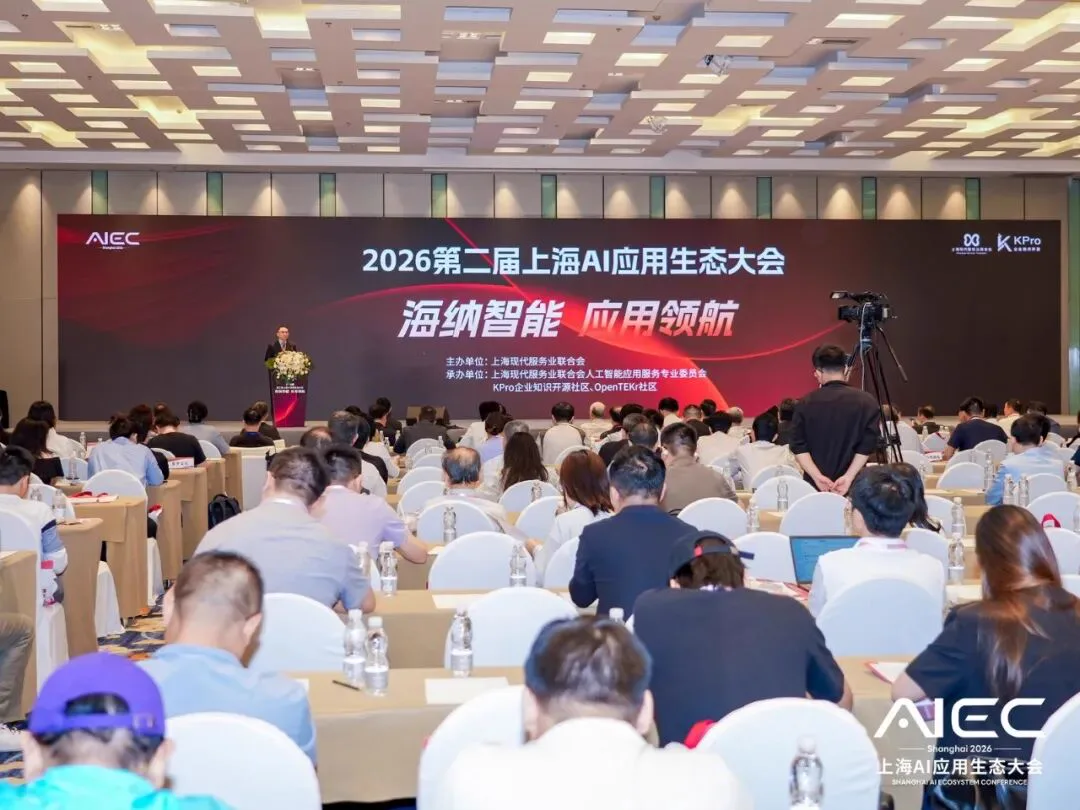
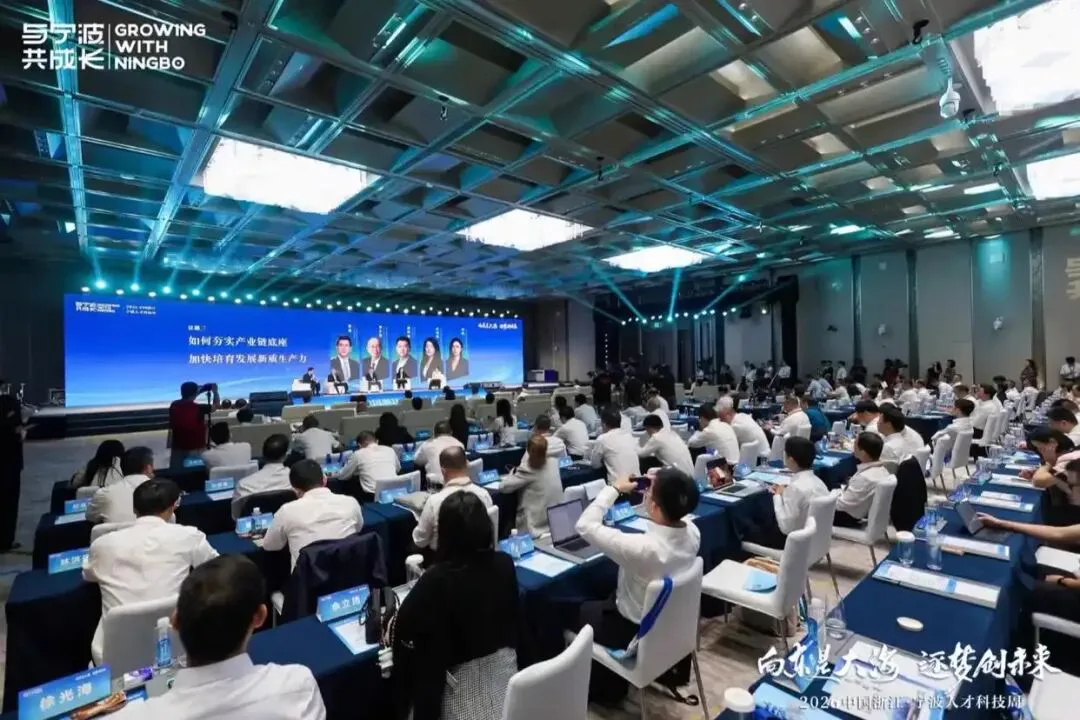
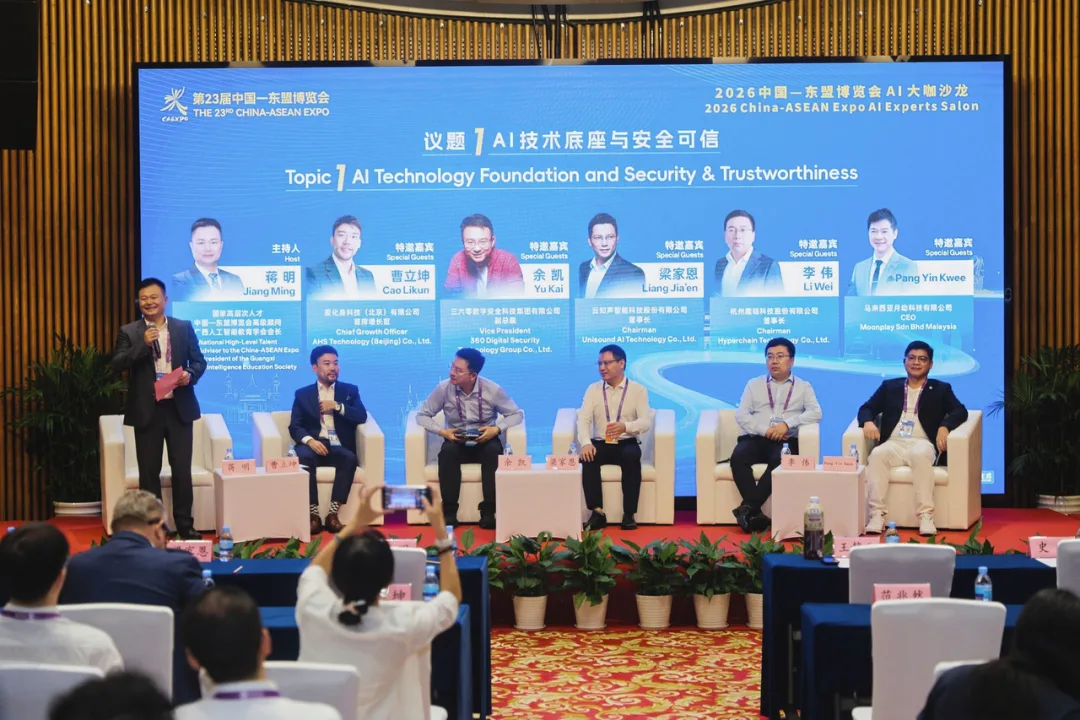
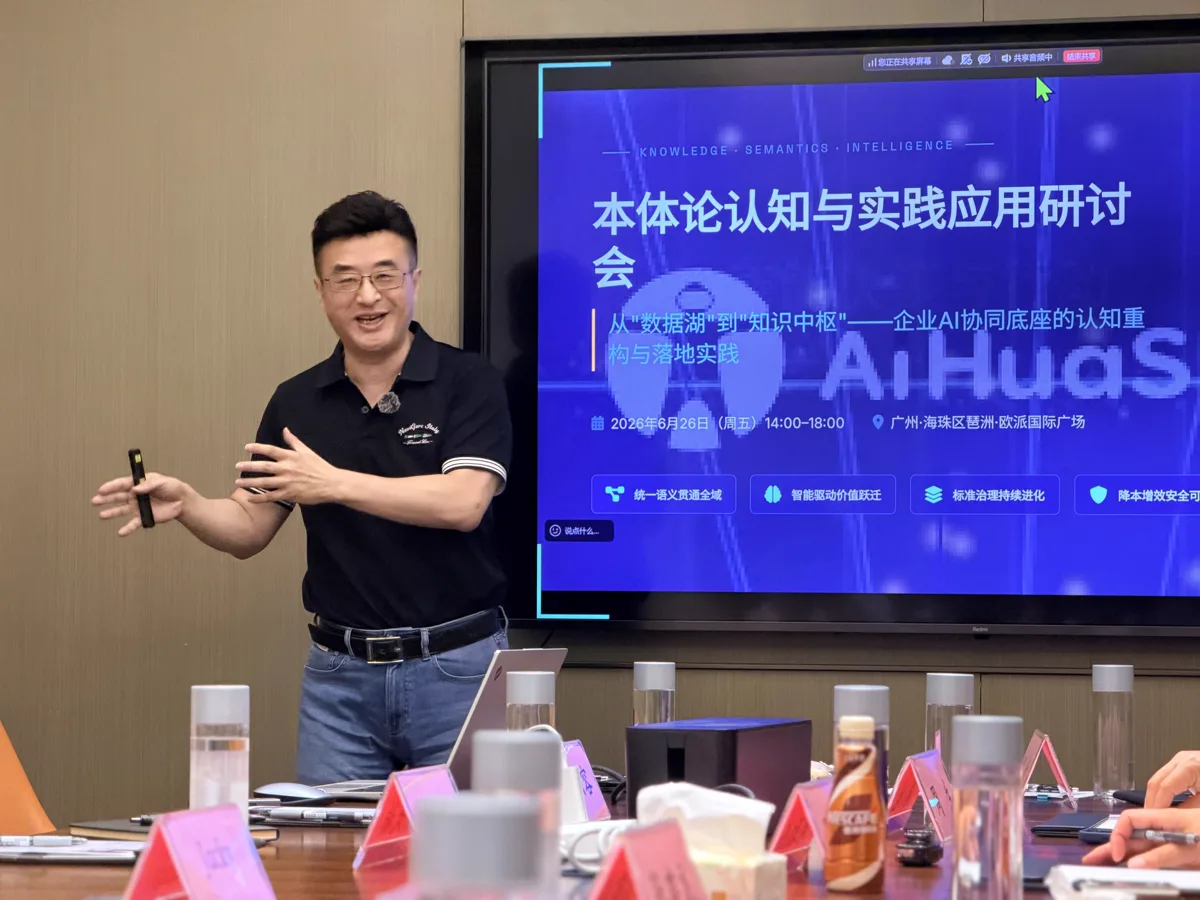
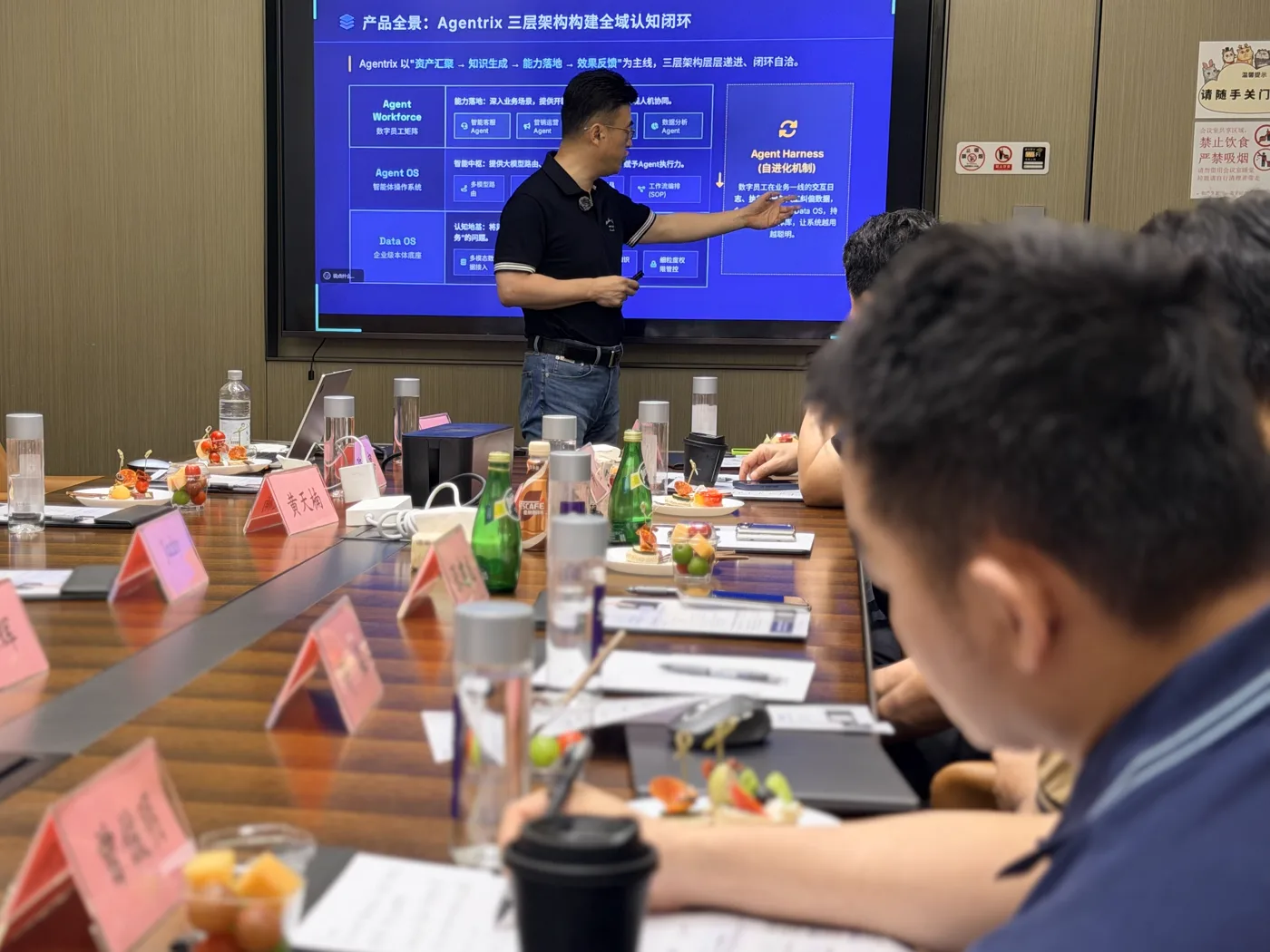
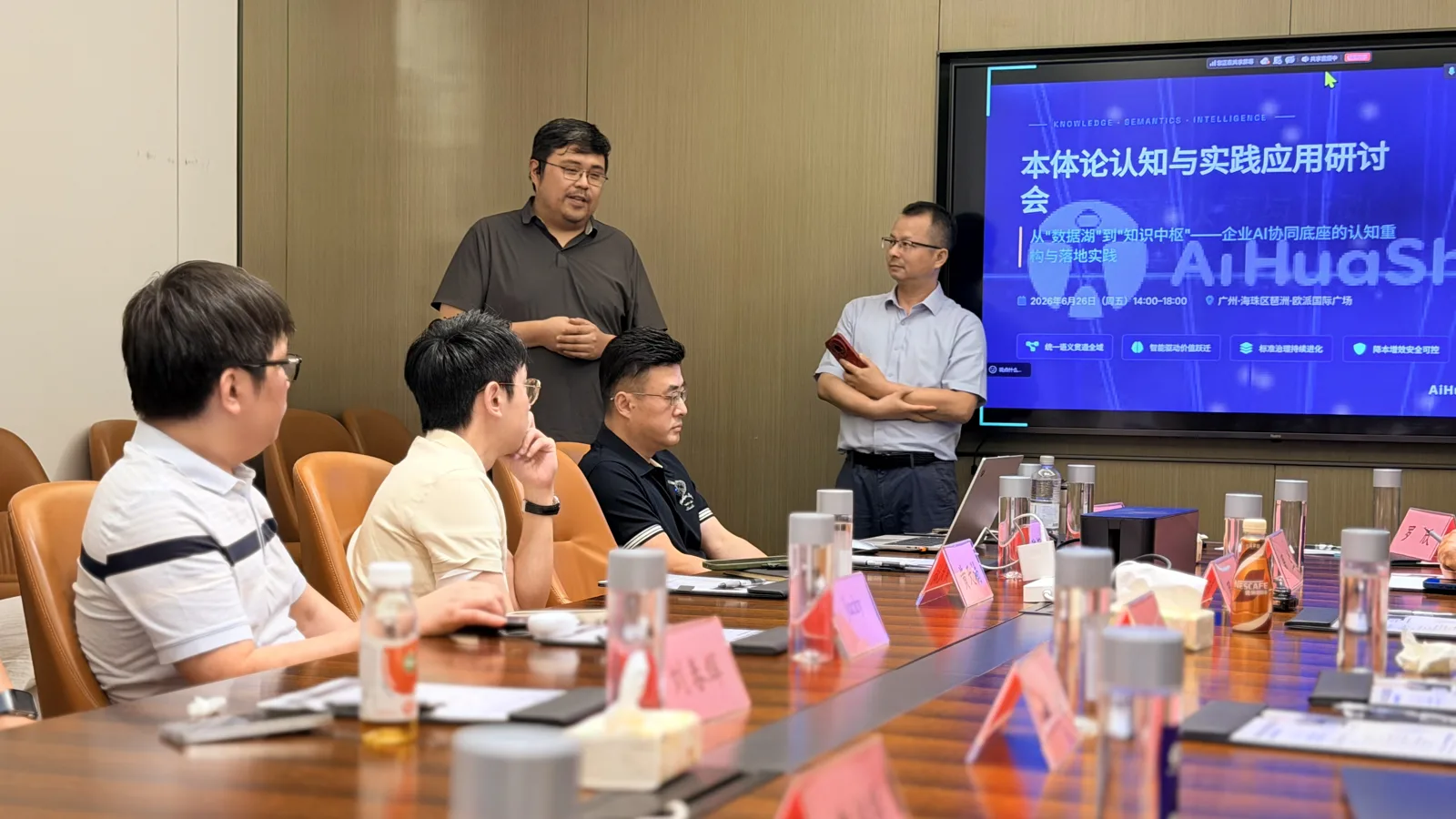
On June 26, a closed-door enterprise agent seminar on the theme of "ontological thinking and applied practice" was held in Guangzhou. More than a dozen business leaders from finance, energy, manufacturing, retail, and public services attended, along with decision-makers responsible for intelligent transformation. The session was led by AHS Vice President Jackson Chen, who built it around a central proposition — letting AI understand the enterprise, and letting intelligence take part in running it — guiding participants out of the shallows of technology adoption and into a systematic understanding of business essence and ontological operating logic.
Core insight: the watershed for enterprise AI lies not in how powerful the model is or how much compute is available, but in whether a company can take the implicit "because … therefore …" chains buried in its operations and make them explicit as an executable, auditable, and evolvable ontology.
1. Background: from the data governance impasse to the question of the business logic chain
The agenda went straight at the bottleneck facing enterprise AI today: after years of data governance projects and substantial investment, why does AI still struggle to genuinely understand the business and make decisions that follow its logic?
In day-to-day operations, a great many critical judgements rest on implicit "because X, therefore Y" reasoning — why was this customer's credit application declined? why did this order go through special approval? Behind each of these decisions lies a clear chain of business logic. Yet those chains usually survive only as experience, convention, or scattered documents inside the organization. They resist systematic expression, and so become "dark knowledge" that AI cannot reach.
The crux of the problem thus comes into focus: what an enterprise lacks may not be data, but the internal capacity to express the relationships among data and the rules of the business in a structured way — that implicit logic chain running through every business process.
The focus of this closed-door session was precisely how to turn that chain from implicit to explicit — from blurred experience into computable, expressible, structured business assets — so that enterprise-grade agents can understand the business and take part in decisions.
2. The talk: ontology, or the technical path from data silos to semantic networks
Chen opened with an analogy: "If an enterprise is a living organism, data is its blood and compute is its muscle — then the ontology is the brain and nervous system. It defines how the enterprise understands itself and how it interacts with its environment."
He then walked through a demo showing how core business objects such as "customer," "order," and "contract" are extracted from heterogeneous internal systems — ERP, CRM, OA — and woven into a network of semantic relationships.
"The reason data lake and data middle-platform projects failed to deliver the expected ROI on intelligent transformation," Chen said, "is that the data was made for people to read. It lacks a semantic layer that AI can understand. What AI sees is a pile of isolated, meaningless numbers and strings." He traced the evolution of enterprise AI technology: from RAG (retrieval-augmented generation), which depends on external knowledge, to GraphRAG, which brings in internal knowledge-graph relationships, and finally to OAG (ontology-augmented generation), centered on the enterprise's own business logic.
The ontology is an enterprise's own moat. It does not depend on the capability of an external foundation model; it makes the implicit, word-of-mouth know-how inside the company explicit, as a structured asset that can be inherited, optimized, and executed.
An ontology does not merely describe what the business is — it can drive what the system does.
He cited the case of Qiaoyin, the first urban services company listed on China's A-share market. Using the Agentrix intelligent system, the company built a business ontology that made explicit the operating logic behind complex real-time dispatching, process coordination, early risk intervention, and advance anomaly warning. Working from that business ontology and a world behavior model, it achieved dynamic decision optimization — delivering a marked lift in operating efficiency and a reduction in operating cost, while cutting dispatch response from hours to minutes.
In Chen's view, enterprise transformation is moving through distinct stages: from informatization (building IT systems) to digitalization (data-driven processes), and finally toward AI-ification (agents participating in operations) — and ontology is the key infrastructure underpinning that final stage.
3. Questions from the floor
The closing segment was an open exchange with the attending companies. Their grasp of ontology no longer floated at the level of concept; the questions cut into the sinew of technical delivery and commercial return.
1. Semantic consistency: when different systems inside a company name the same thing differently, how can AI understand it correctly and validate it?
Question from the floor: "Our ERP has been running for years and many table fields have no unified data dictionary at all. Take 'inventory' — it means one thing to finance, another to production, another to the warehouse. Without a data dictionary, how is AI supposed to know what each field actually means in business terms, just from table and field names?"
Qi Xiaoxi, product expert at AHS: "We use a layered strategy. First, the Agentrix system draws on any data dictionary the enterprise already has as the authoritative source. Where none exists, a foundation model infers the likely semantics of each field from table structure, naming patterns, inter-table relationships, and business context, and generates annotations. Business experts then review and correct those inferences, closing a human-in-the-loop semantic annotation cycle. It is a double-safety mechanism."
Question from the floor: "In ERP and CRM, the fields and the wording that define a 'customer' are different. After cleansing, how do you determine that they are the same object?"
Qi Xiaoxi, product expert at AHS: "Through semantic unification rules and a source-clustering mechanism. The system automatically discovers the mapping between different names — client_code and customer_id, for instance — and validates it through data-lineage analysis. In essence, Agentrix is building a unified cognitive layer of business objects that sits above the naming of any particular system."
2. Rule engine: when a business exception falls outside company policy, how does AI recognize it and improve the existing rules?
Question from the floor: "We hold a lot of store lease contracts in which the rent calculation is written out in prose. Do the rules have to be entered manually one by one, or can the system read the contract text and extract structured calculation rules automatically? Could a clause such as 'how to handle amounts above five million' become a structured rule AI can execute?"
Qi Xiaoxi, product expert at AHS: "Our system can analyze unstructured documents — Word, PDF, scans, Excel — and extract structured business rules automatically. From a lease contract, for example, it can identify a 'base rent plus percentage of turnover' calculation. Manual definition and maintenance are supported as well. Beyond that, it can spot implicit patterns in historical operating data: if a certain class of expense claim always exceeds budget yet is always approved, the system learns that 'tacit rule' and suggests making it explicit."
Question from the floor: "Company policy cannot enumerate every contingency. Travel reimbursement has a standard fare, but an urgent project may leave no option except a full-price ticket. How do the rules cope with exceptions like that?"
Guo Lin, CTO of AHS: "Our DataOS rule engine uses a three-layer hybrid reasoning mechanism. First, OWL constraint rules handle deterministic, explicitly stated policy requirements through logical inference. Second, machine learning identifies 'tacit rules' in historical approval data — patterns that are never written down yet are consistently approved in practice — and proposes formalizing them. Third, the foundation model provides flexible adaptation for exceptions that policy cannot enumerate, such as an over-standard travel claim arising from an urgent project."
Jackson Chen, Vice President of AHS: "A key capability of the ontology is self-evolution. Drawing on historical operating data, the system keeps learning and can propose new rules or refinements to existing ones, so that a company's policy framework evolves dynamically alongside its business."
3. Decision reasoning: in business-critical scenarios, how can AI reasoning be made as rigorous and legible as a mathematical proof?
Question from the floor: "Our bid evaluation panel has seven members, and we constantly worry that if the judgement of the majority is swayed, the reliability of the result drops. Could AI make the final decision? And the question that follows: how do we make sure the AI's judgement is not guesswork out of thin air?"
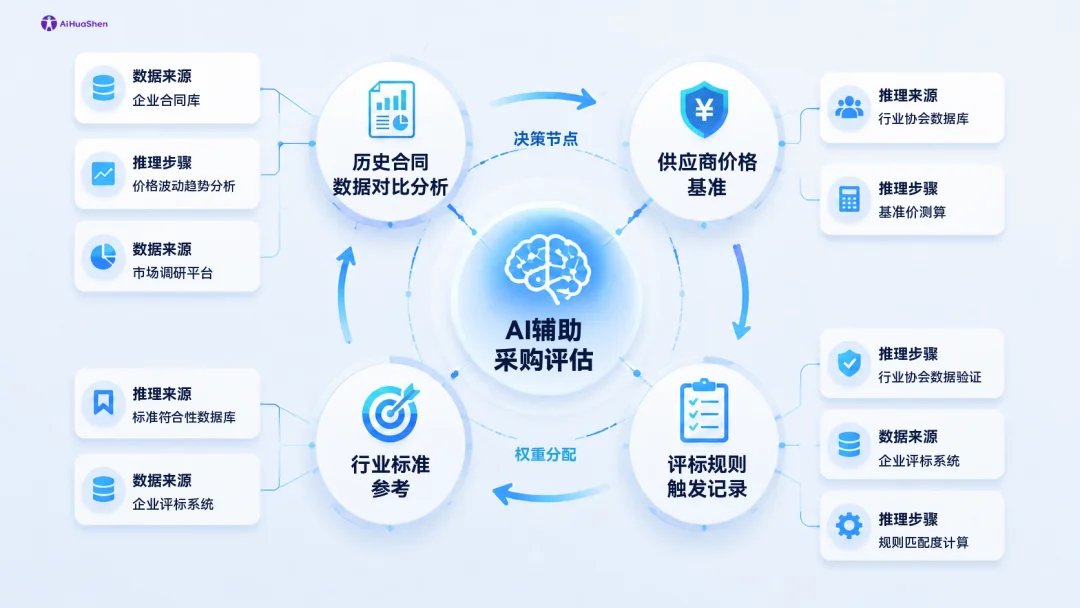
Qi Xiaoxi, product expert at AHS: "AI can take on evaluation and audit work, though critical stages such as commercial negotiation still need people. The core value of AI assistance is not a black-box answer; it is a complete, traceable evidence chain behind the reasoning. In supplier assessment, for instance, the system shows not only that a supplier's price may be inflated, but on what basis — comparison against historical contracts, deviation from industry benchmarks, or which rule checks were triggered. Every step of the judgement is backed by data or rules and can be traced end to end. As long as a person can clearly define 'because of this, therefore that judgement,' AI can learn and reuse that decision chain."
Jackson Chen, Vice President of AHS: "This is fundamentally the difference between logical determinism and probabilistic matching. A foundation model works on probability — right today, wrong tomorrow. Ontological reasoning computes over defined logical rules and data; as long as the rules and the data are correct, the result is deterministic and repeatable. The ontology lets AI's thinking be as clear as a mathematical proof."
Question from the floor: "I would like to train AI on ten years of supplier contracts so that when a new supplier quotes, it automatically flags which prices are inflated. Is that achievable?"
Guo Lin, CTO of AHS: "Price analysis on in-domain historical data is straightforward. But contract pricing cannot be read from internal data alone — it is also shaped by market conditions and economic cycles, so multi-source analysis is essential. If the procurement manager can state the basis explicitly — 'because steel prices have risen 15 percent recently, I accept this quote' — AI can retain that causal logic and apply it automatically the next time similar market conditions arise. The heart of the matter is still whether the evidence chain is complete."
Question from the floor: "Water and energy have many complex operating rules — the oxygen dosing rate in an aeration tank for wastewater treatment, for example. Do those require purpose-trained predictive models?"
Guo Lin, CTO of AHS: "It depends on the scenario. Straightforward quote comparison or compliance checking can be reduced to an explicit evidence chain: a person makes the judgement once, and AI executes it thereafter. But complex process control in production, which involves expert-experience models and real-time sensor data, genuinely does require dedicated predictive models. Our ontology system can encapsulate and invoke those specialist models, closing the loop from business rules through to control strategy."
4. PaaS architecture: independent of any foundation model, Agentrix reasoning over the ontology is deterministic logical execution
Question from the floor: "Foundation models differ in general capability. If we invest heavily in building an excellent ontology but the 'brain' we plug in is not smart enough, what then?"
Guo Lin, CTO of AHS: "We use a model-agnostic PaaS architecture. The system's core policy judgement logic is carried entirely by the ontology layer, which defines under what conditions which action is taken; the foundation model serves mainly as an efficient natural-language interface and task executor. That is why the system runs stably even with a smaller model. More importantly, a company that depends entirely on an external model's capability has built no moat of its own. Real, non-replicable competitiveness lies in a company's own business data, its hard-won business rules, and the causal network rooted in its industry know-how. Structured through the ontology, these are the core barrier of enterprise intelligence."
Risks of a path heavily dependent on foundation models: model capability becomes the ceiling, and results are bounded by the general capability of the chosen model; there is no core barrier, since competitors can use the same model, driving severe homogenization; cost and risk are hard to control, as API costs move with model pricing and supply-chain risk persists; and business logic turns into a black box, leaving complex decisions difficult to audit or explain.
Advantages of the ontology-driven, model-agnostic path: business logic becomes self-governed, with core judgement rules carried by the company's own ontology and high determinism; a proprietary moat is built, because competitiveness stems from a unique business knowledge graph that is hard to replicate; cost and architecture stay flexible, allowing the best value model to be chosen without lock-in; and the process is transparent and auditable, since reasoning rests on explicit rules and evidence chains that can be traced end to end.
Question from the floor: "During implementation, how do you guarantee the accuracy of the intelligent system? Will it hallucinate the way foundation models do? And if business rules change, does the whole system have to be rebuilt from scratch?"
Guo Lin, CTO of AHS: "Ontology-based reasoning is deterministic logical execution, fundamentally different from the probabilistic generation of a foundation model. It behaves like a written program: as long as the inputs and rules are correct, the output must be correct. If a result is wrong, it can always be traced to a bug in a specific logical step — a mis-defined rule, a bad data mapping — and fixed. That is nothing like the hallucination problem that is so hard to eradicate in foundation models. When business rules change, a business expert simply revises or adds the corresponding rule definitions in the ontology layer; there is no need to retrain a complex machine learning model, which greatly reduces maintenance cost and complexity."
Question from the floor: "Can ordinary business staff take part in building the ontology directly — for instance, querying data and recording the result straight away as a new metric or a new ontology, to cut cost and move faster?"
Guo Lin, CTO of AHS: "That is exactly the direction enterprise agent systems are heading — self-iteration. But enterprise-grade applications must balance flexibility against discipline. We favor settling knowledge into a database, particularly a graph database, rather than stuffing everything into the model's context. The key shift is from 'throw in all the experience at once' to 'discover relationships progressively, retrieve on demand.' High-frequency, high-value operations are consolidated into reusable skills. Today, packaging a skill still requires technical involvement, but the goal is for business staff to generate and refine these business logic modules quickly through natural-language description."
5. Engagement model: not the delivery of a tool — with ontology first and governance second, every step is anchored to business value
Question from the floor: "If we adopt your enterprise AI system, what does the engagement actually look like? Software licenses, a subscription, or something else?"
Guo Lin, CTO of AHS: "We lean toward a deep partnership built as a joint venture — investing together with the client, sharing the risk and sharing the returns — rather than selling standardized software. Building an ontology demands a deep understanding of the business; it is never solved by handing over a tool. This draws on the forward-deployed engineer (FDE) model used by Silicon Valley firms: we send experts to work on site over the long term, alongside the business teams. The commitment belongs to the category of strategic digital transformation. We advise clients to begin with a pilot in a specific scenario and expand into core processes once results are visible. This 'ontology first, governance second' path ensures every unit of investment points directly at business value, and breaks the vicious circle in which traditional data projects stall the moment they are delivered."
The next enterprise ontology closed-door seminar is in preparation. Contact AHS to obtain a tailored enterprise agent solution, or to reserve a seat at the next session.