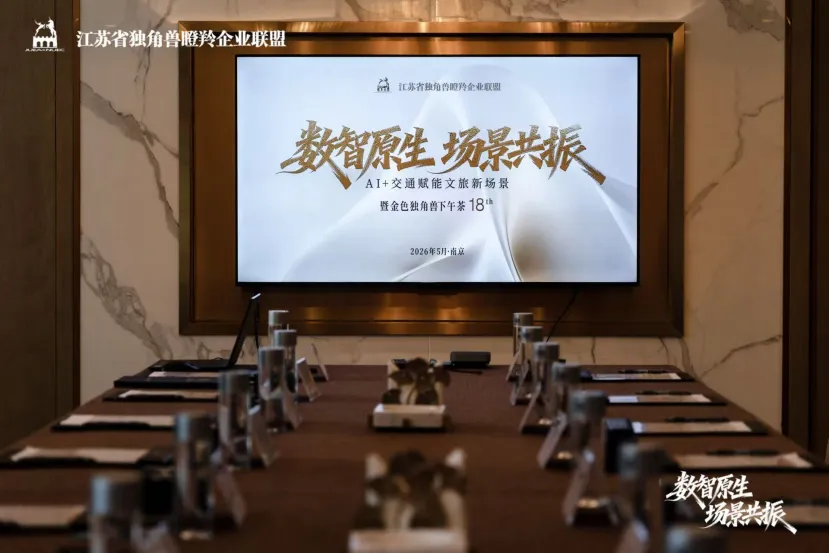
On May 22, the Golden Unicorn Afternoon Tea, hosted by the Jiangsu Unicorn and Gazelle Enterprise Alliance, was held in Nanjing. Centered on the theme AI + Transportation Empowering New Cultural Tourism Scenarios, the roundtable brought together perspectives on artificial intelligence, the low-altitude economy, smart transportation, and the integration of culture and tourism.
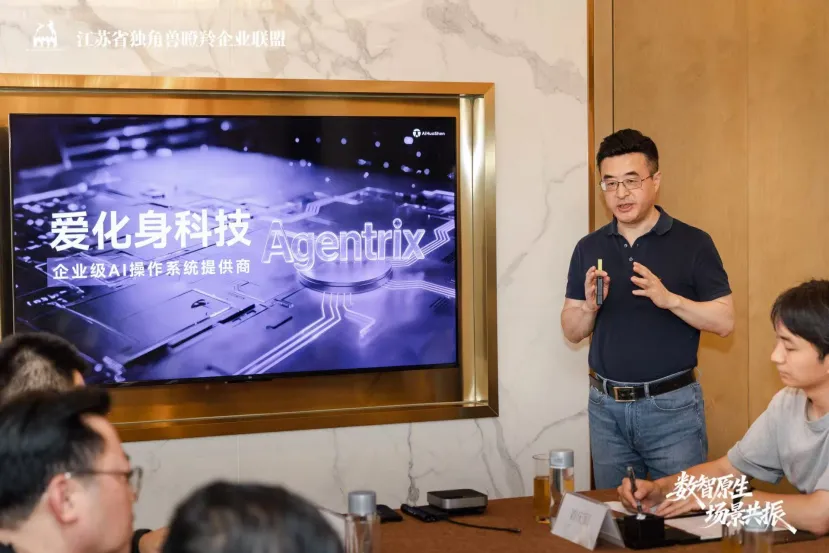
As an enterprise AGI and agent platform company, AHS was invited to join the roundtable discussion and share the practical capabilities of the Agentrix agent platform in urban governance, transportation coordination, and intelligent scheduling for complex scenarios.
At the event, Chen Jun, Vice President of AHS, presented Agentrix's three-layer architecture: Data OS as the data foundation, Agent OS as the orchestration hub, and Agent Workforce as the digital employee cluster. Built for the complex organizational and industrial scenarios of large enterprises, Agentrix can create AI digital teams with capabilities for perception, analysis, decision-making, and execution. It breaks through the barriers between technology and application in digital-intelligence transformation, helping enterprises and urban systems move from intelligent tool assistance to intelligent collaboration.
Speaking to the needs of intelligent transformation in cultural tourism, Chen Jun noted that the goal is not to deploy isolated digital tools, but to build a complete closed-loop capability around perception, decision-making, scheduling, and execution.
Application Paths for AI and Digital Twins in Cultural Tourism Scenarios
Scenic-area shuttles and visitor flow management:Use agents to enable efficient resource scheduling and traffic prediction.
Emergency response mechanisms:Use self-aware systems to improve closed-loop handling efficiency for incidents.
Commercial closed-loop development:Drive a virtuous cycle of technology R&D, scenario validation, commercial deployment, and capital support.
Enterprise AGI will gradually become a new form of infrastructure supporting urban operations and industrial collaboration.
Chen Jun said that as the low-altitude economy, urban agents, and industrial AI infrastructure continue to develop, the boundaries between transportation, cultural tourism, and urban governance are being reconnected. In the future, enterprise AGI will no longer be a standalone software capability; it will gradually become a new form of infrastructure supporting urban operations and industrial collaboration.
Representatives from Jiangsu Cultural Investment Group, technology companies, and investment institutions also participated in the roundtable.