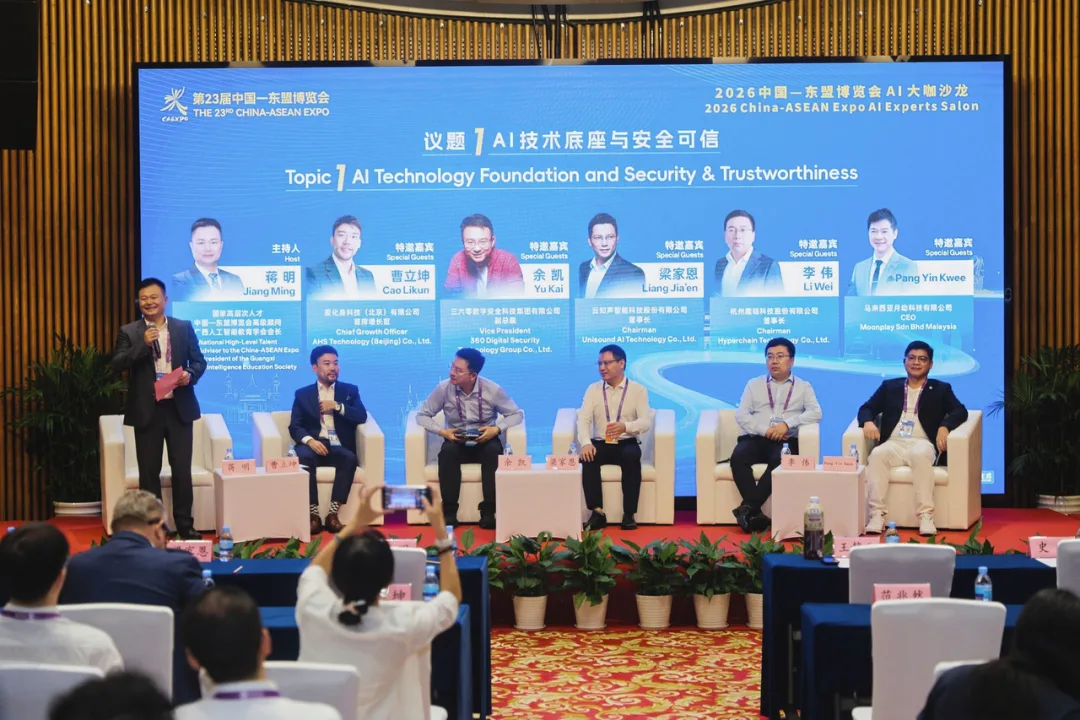
According to IPO Zao Dao, enterprise AGI company AHS's Hong Kong AI entity and Berkshire Hathaway HomeServices Gulf Properties recently signed a cooperation framework.
AHS has also raised funding from institutions including Jinyu Capital and Shenzhen HI-Tech Investment, plus listed investors such as Sinosig and Richinfo.
Founded in 2021, AHS builds enterprise AGI on a world behavior model for very large organizations—agents that understand business, execute tasks, evolve continuously, and become thousands of digital workers with clear roles, boundaries, and KPIs.
AHS targets enterprises that already chose an AI strategy and need systematic deployment—not firms still watching from the sidelines. The real question is how fast AI enters core workflows, carries real tasks, joins decision and execution loops, and becomes new organizational productivity.
Building an integrated three-layer agent platform
Concretely, AHS has built AHS Agentrix—a three-layer integrated agent platform.

Data OS is the foundation, helping AI understand business processes and organization. In most enterprises, raw data scattered across systems, roles, and devices looks inconsistent, semantically unclear, and poorly related to AI.
Data OS extracts and vectorizes raw data into a unified language models and agents can understand, call, and reason over.
Agent OS and Agent Workforce form the decision brain and frontline digital workers.
Agent OS orchestrates hundreds or thousands of agents under one organizational logic. With awareness of digital and physical events, agents run closed loops: discover → analyze → recommend → human confirm → execute → supervise → feedback.
Agent Workforce upgrades AI from tools to role-bound digital staff—telemarketing agents, finance reconciliation agents, regional allocation agents, anomaly monitoring agents—always-on, schedulable labor inside the enterprise.
Agentrix is built by a PKU-rooted engineering team; over 80% of AHS R&D comes from Peking University.
CTO Guo Lin, former PKU software & microelectronics mentor, leads world behavior model and systems architecture. He has 12 years of serial entrepreneurship building platforms for Microsoft, Siemens, and other large customers.
In AHS's model, engineers are action units deployed inside complex systems—translating customer needs, technical constraints, and business goals between the field and the agent platform into executable software.
Partnerships with leading enterprises
Palantir's stack is also a three-layer loop: data and semantics (Foundry/Ontology), agents and applications (AIP), and deployment operations (Apollo).
Similarity does not equal success. China has no shortage of Palantir storytellers—the hard part is pulling the story off the architecture slide into customer sites.
Energy, manufacturing, telecom, and transportation have the most complex organizations, largest data assets, and the strictest efficiency, safety, and governance demands.
Listed urban services leader Qiaoyin partnered with AHS in a joint venture, connecting air, space, ground, water, living, and production data with Agentrix's three layers to rebuild city services end-to-end—marking a shift from traditional environmental and municipal operations to intelligent, fine-grained management.
China Merchants Shekou collaborates on smart property and space operations—embedding agents across service touchpoints for repairs, visitor access, inquiries, billing reminders, community notices, and smart home control.
Fintech firm Dong'an Tech uses Agentrix for automated non-performing asset management in credit scenarios. Agentrix also powers pediatric hospital voice translation, government hotline agents, and multilingual tour guides overseas.
More than another "China Palantir"
Guo Lin sees Agentrix fitting enterprises with digital maturity around 60–70: foundational systems and data exist, but coordination, automation, decision intelligence, and role execution still hold large agent-shaped upside.
Below 60, data and process digitization are incomplete—AI cannot embed in workflows. Above 80, strong in-house AI teams may compete with external agent platforms.
Agentrix's "general base" abstracts reusable industry cognitive cores, then adapts per customer—roughly 80% shared industry kernel plus 20% scenario parameters.
Industry knowledge abstracted into vectors unlocks value in vertical scenes, Guo Lin said.
Agentrix evolves in a self-reinforcing loop: industry knowledge, business rules, and execution feedback become structured assets that improve the decision brain and scenario reuse.
Organizationally and technically, AHS is not just another "China Palantir"—it points to a localized, leapfrog evolution of enterprise AGI platforms as agents become industry infrastructure.
While exporting enterprise AGI outward, AHS is also running an AI-native transformation inside.
After two years of rebuilding, except mission, vision, and culture that still need human carriers, AHS's business processes are approaching intelligent scheduling and automated closed loops.
"Higher internal productivity, in turn, helps us build digital productivity for customers more efficiently," Guo Lin said.
Republished from IPO Zao Zhi Dao