Recently, a post by Wang Huiwen on Jike unintentionally revealed an intriguing phenomenon: China’s most competitive AI companies are rapidly clustering into the same neighborhood.
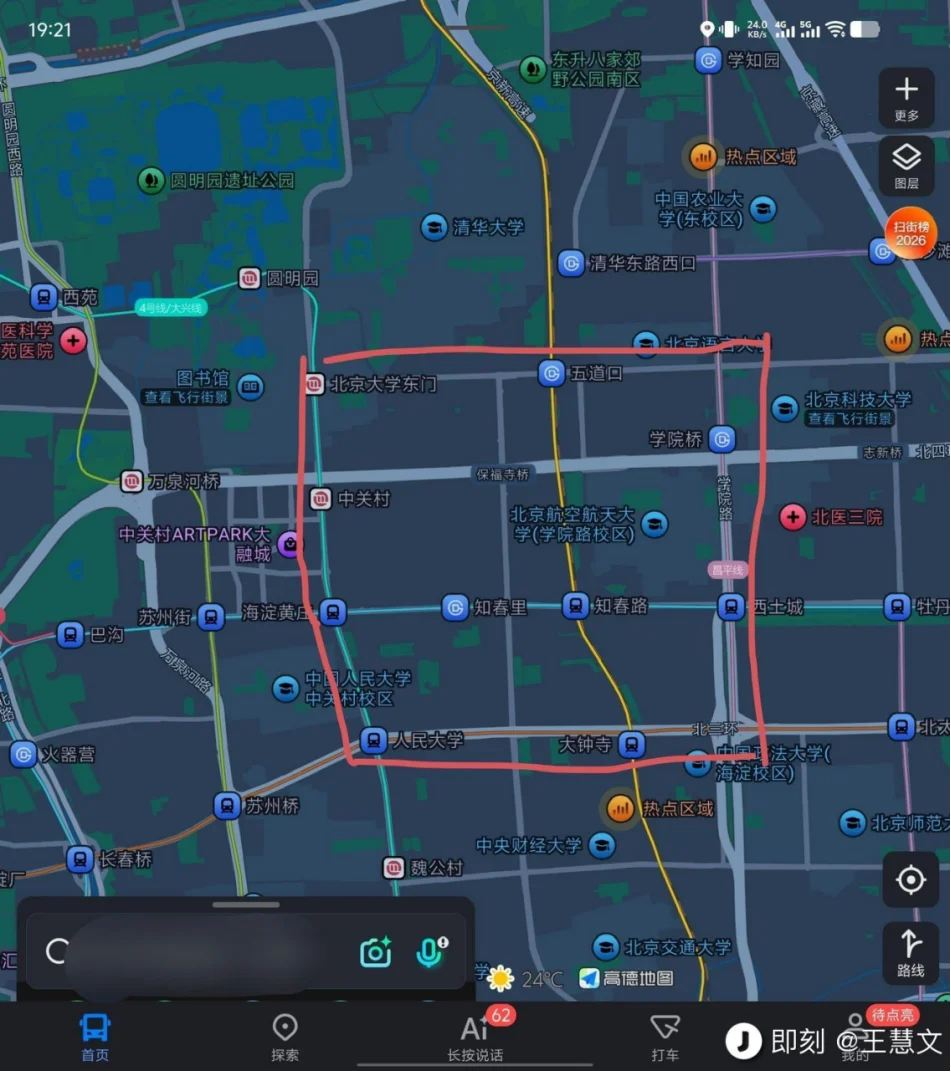
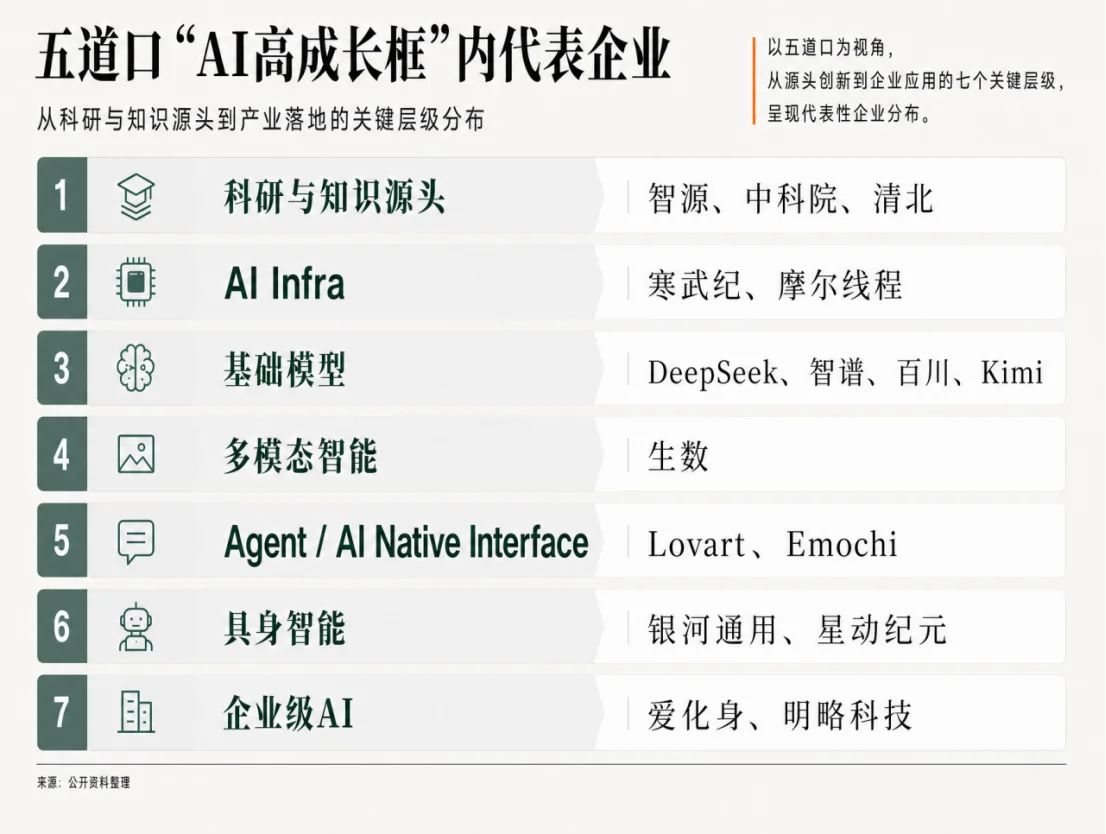
After reviewing his own portfolio, Wang noted that if one draws a box on the map of Beijing — south of Tsinghua University, east of Peking University, west of Xueyuan Road, and north of Dazhongsi — the projects inside that box have delivered notably better investment returns than those outside it. Even more interestingly, this pattern applies not only to the AI projects he invested in, but also to companies he missed, such as DeepSeek, Zhipu, Lovart, and Emochi, all of which are located in the same area.
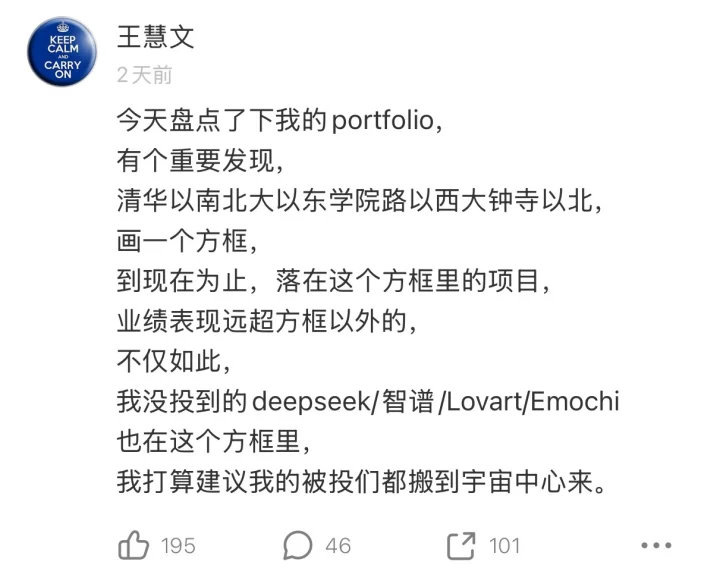
This bit of “geographic mysticism” led him to remark that, in the future, he would advise all his portfolio companies to move to the “center of the universe.”
China’s internet startup history has had geographic centers before, but after the pandemic, the logic of SaaS-enabled remote work once gained the upper hand. Now, as AI founders face weekly model iterations and an extremely short half-life of information advantage, “back-to-back work” — where a conversation is only a turn of the chair away — is once again becoming the dominant mode. This is especially true for foundational models, inference optimization, infrastructure, and related fields, which naturally require founders, researchers, engineers, and product leads to work in an environment of constant, high-frequency collision.
AI is, at its core, an industry of cognitive productivity.
Within Wang Huiwen’s “AI high-growth box,” beyond Peking University and Tsinghua University on its edges, are institutions such as Renmin University of China, Beihang University, Beijing Language and Culture University, and China University of Geosciences. The area brings together more than 15 national key laboratories, seven national-level research institutions, and companies including Google, Microsoft, IBM, Intel, AMD, ByteDance, Cambricon, Lenovo, and Xiaomi — making it arguably one of the densest talent soils in the country.
In the internet era, R&D teams could be distributed across Beijing, Shenzhen, Hangzhou, or even multiple cities and still ship products successfully. Most internet projects competed on product cadence, user acquisition, and operational efficiency. AI is different: model iteration depends on denser talent collaboration; training and inference depend on heavier compute resources; product deployment depends on faster data feedback; and technical judgment is tightly linked to the latest papers, open-source communities, and laboratory developments.
That is why, for today’s AI startups, the truly expensive resource is proximity to top talent — or, more precisely, proximity to the next emerging technical consensus and to high-intensity cognitive collaboration.
When DeepSeek moved its R&D department to Beijing in early 2023, it reportedly surveyed several top office buildings near Tsinghua and Peking University before ultimately settling in Raycom InfoTech Park in Haidian. AHS, an enterprise AGI company, chose a site on Beisihuan Middle Road in Haidian, next to the former startup location of Yu Minhong, an alumnus of Peking University. “It’s a 15-minute bike ride back to PKU, which makes recruiting easier.”
Zooming out, the area also hosts 30 to 40 domestic venture capital firms, more than 10 government-guided funds, and seven or eight China offices of overseas funds. In other words, stripped of any prior bias, Wang Huiwen’s “AI high-growth box” also points to a higher probability of success. It is not that there are no AI companies outside the box; rather, this area increasingly and consistently raises the odds that an early-stage AI company can secure talent, consensus, funding, and resources.
“To invest in these companies, we moved near Tsinghua ourselves,” said the head of one investment firm.
According to data from Ruishou Analysis, AI companies accounted for 67% of early-stage financing — seed, angel, and Series A rounds — in 2025, showing a clear “siphon effect” of capital. Series A rounds are also increasingly turning into frequent “A++” rounds: because VCs are unwilling to wait for the next round, AI companies are being split into successive financing tranches as investors rush to secure allocation and timing. “Not investing in AI is equivalent to exiting the competition for the future of technology.”
“When entrepreneurs are building something outside AI, we always ask: why can’t this be done again with AI?” the same investor said.
Dense teams of top-tier talent, tight data feedback loops, AI-native organizational structures, and cognitively strong founders — the traits used to judge whether an AI company has truly taken shape — are typical features of the companies inside Wang Huiwen’s “AI high-growth box.”
What is interesting is that nearly every key direction — from large models, AI infrastructure, and agents to multimodal applications, embodied intelligence, enterprise AI, and globalization-focused teams — has representative examples within this relatively small area.
On the very day Zhipu headed to Hong Kong for its listing, just across the street at the Beijing Academy of Artificial Intelligence, a session on the “Top 10 AI Technology Trends for 2026” was taking place in the first-floor auditorium.
China’s AI “Silicon Valley moment” is beginning to acquire real coordinates of its own — the kind associated with Palo Alto and Mountain View.
Republished from Chuangye Bang